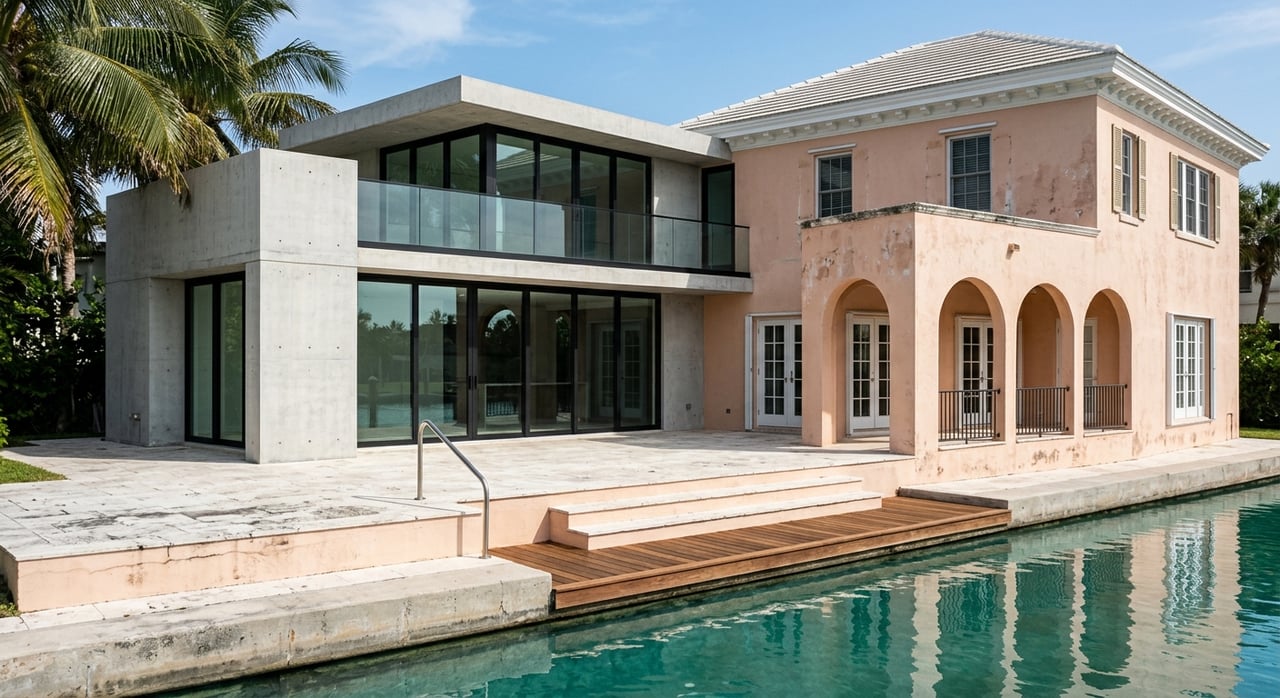
Trying to decide whether to renovate an older waterfront home in Aqualane Shores or start fresh with a new build? In this neighborhood, that choice is often about far more than finishes or floor plans. You need to weigh the lot, floodplain rules, elevation, water access, timeline, and long-term resale appeal. If you are considering a purchase or evaluating what to do with a property you already own, this guide will help you think through the decision with more clarity. Let’s dive in.
Why the lot often drives the decision
Aqualane Shores is a waterfront neighborhood in the City of Naples, located between Port Royal and Old Naples. Historical coverage describes roughly 370 large home sites across about 300 acres, with many original homes from the 1960s later replaced by larger residences. That redevelopment history matters because it shows how often buyers and owners here are really evaluating the parcel as much as the house itself, according to Naples Daily News historical coverage.
The location also comes with real site-specific considerations. The City of Naples says the Aqualane Shores sub-basin is low-lying, mostly residential, and reliant on gravity drainage, which increases sensitivity to tidal effects and rising sea levels in this part of the city, as outlined in the Basin IV assessment. That means the best answer is not always “renovate” or “rebuild” in the abstract. It is often, “What does this specific lot support best?”
When building new makes more sense
The 50% rule can change everything
One of the first checkpoints is the City of Naples substantial-improvement standard. The city explains that if reconstruction, rehabilitation, additions, or other improvements reach at least 50% of the market value of the structure, the home must be brought into current flood compliance under the city’s floodplain development rules.
That detail is especially important in Aqualane Shores because the calculation uses the structure value only, not the land value. On a waterfront parcel where land may represent a large share of total value, owners sometimes assume a major renovation will stay below the threshold, but that is not always the case. If your renovation budget is nearing that mark, a new build can become the cleaner path.
New homes align with current code
The City of Naples states that permits submitted on or after December 31, 2023 must comply with the 8th Edition Florida Building Code. City guidance also notes that all new construction and substantial improvements must meet current flood provisions.
The practical advantage is straightforward. A new home is designed from day one around current code, current engineering standards, and current flood requirements. In a waterfront setting, that can reduce uncertainty during design, permitting, and eventual resale.
Resiliency is a major factor
Naples also notes that recent construction practices and regulations make newer structures less prone to flood and hurricane damage, while many older homes remain more vulnerable under the city’s flood mitigation guidance. If you are comparing renovation costs against a teardown, resiliency should be part of the conversation, not an afterthought.
This matters not only for day-to-day ownership, but also for future marketability. Buyers in waterfront neighborhoods tend to pay close attention to compliance, building systems, and how much risk or deferred work may be waiting after closing.
New construction fits modern luxury expectations
Buyer expectations have changed. Current design trends highlighted by the National Association of Home Builders include indoor-outdoor flow, larger openings, natural light, warm wood elements, flex spaces, high-performance windows, tighter building envelopes, and solar integration.
In Aqualane Shores, a new build can make it easier to deliver that full package in one cohesive design. If your goal is a waterfront home with strong resale appeal and a floor plan that feels current from the start, building new may offer the clearest route.
When renovating may be the better move
A solid structure can be worth saving
Renovation can make sense when the existing home already has a workable footprint, acceptable elevation, or a shell that supports meaningful modernization. In a neighborhood with many older homes, there are cases where preserving and improving what is there can be more efficient than starting from zero.
That said, the lot still matters. Aqualane Shores has seen decades of redevelopment, and that history suggests owners often need to judge whether the existing structure adds real value or simply occupies a valuable parcel, based on the neighborhood’s historical redevelopment pattern.
Renovation can be faster
Timeline is one of the biggest reasons owners consider renovation. Local Naples-area planning ranges cited in the research suggest whole-home remodels can sometimes be completed in a matter of months, while custom new construction often takes much longer when you combine design, permitting, and build time, according to local project timing examples from Goyal Development.
These are not guarantees, but the contrast is useful. If speed matters and the house is a strong candidate for improvement, a renovation may deserve serious consideration.
Renovation still needs flood review
A shorter timeline does not mean an easier compliance path. The City of Naples says all permitted work in a Special Flood Hazard Area requires either an Elevation Certificate showing compliance or a city FEMA form, as noted in the city’s building permit forms and fees page. The city also states that 2024 FIRMs are in effect for construction and insurance purposes.
Naples further notes that more than 90% of city addresses are in the Special Flood Hazard Area. In practical terms, most Aqualane Shores owners should expect floodplain review to be part of the process whether they renovate or rebuild.
Partial updates usually do less for resale
A renovated home can still compete well, but the strongest outcomes tend to be comprehensive. Layout improvements, larger openings, indoor-outdoor living, outdoor rooms, and a unified exterior presentation are generally more marketable than a piecemeal refresh, based on current NAHB design trend coverage.
If you renovate, the goal should usually be a finished product that feels intentional and complete. In a luxury waterfront setting, buyers can quickly spot the difference between a true transformation and a cosmetic update.
Waterfront issues to check early
Flood zone and elevation
Before settling on a scope, confirm the official flood zone and elevation status. The City of Naples provides floodplain information tools and access to a Floodplain Coordinator, which can help you understand what the parcel requires.
This step is essential because flood compliance can shape both the cost and feasibility of your project. It is much better to know the constraints at the beginning than after design work is underway.
Marine and shoreline approvals
On a waterfront property, the house is not always the only permitting issue. The City of Naples says riprap construction or repair requires a marine permit, and work seaward of the Coastal Construction Control Line may require state review.
If the parcel is gulf-front or beach-adjacent, the Florida Department of Environmental Protection states that a CCCL permit is required for certain construction and excavation activities. Even if your main focus is the residence, site work near the shoreline can affect timeline and complexity.
Permitting and construction reality
Naples now uses an electronic permitting portal for building, planning, right-of-way, and utilities permits. The portal allows applicants to track corrections, approved documents, and inspections, which helps create more visibility during the process.
For larger redevelopment projects, the Planning Department says a pre-application meeting is required for development review, and submittals are not officially accepted until staff confirms they are complete, according to the city’s planning department information. Single-family zoning districts are not subject to Design Review Board review, so the bigger issues in Aqualane Shores are often floodplain, building, coastal, and utility requirements.
Owners should also plan for real construction disruption. Naples limits construction activity in residential areas to specific days and hours, with stricter weekday limits for demolition, pile driving, and steel erection under the city’s construction hours rules. That may not determine whether you build or renovate, but it should shape your timing expectations.
What tends to matter most at resale
Aqualane Shores has a long track record of owners replacing older homes with larger, newer residences or making major reinvestments in existing properties. That pattern suggests the market tends to reward quality, whether that comes through exceptional new construction or a well-executed renovation.
In most cases, the strongest resale story is the one that reduces buyer uncertainty. That often means code compliance, better elevation, newer systems, resilient materials, and a floor plan that matches current expectations. On some parcels, that points clearly toward a teardown and rebuild. On others, the existing home may offer a strong foundation for a high-level renovation.
A practical way to decide
If you are weighing a purchase or planning your next move with an existing property, start with a parcel-level review before getting attached to one path.
Consider these early checkpoints:
- Compare the county-assessed structure value to your likely renovation budget, since the substantial-improvement test uses structure value only.
- Confirm flood zone and elevation status with the city before finalizing a design direction.
- Ask whether any dock, seawall, riprap, or shoreline work will trigger separate approvals.
- Have your architect or contractor estimate whether the project is likely to cross the 50% substantial-improvement threshold.
- Weigh timeline realistically, including permitting, review cycles, and construction duration.
In Aqualane Shores, the right answer is rarely one-size-fits-all. The smartest decision usually comes from matching the home, the lot, and the regulatory path to your long-term goals. If you want a thoughtful, high-touch perspective on waterfront opportunities in Naples, connect with Annie Hagstrom for guidance tailored to your property goals.
FAQs
Should you build new or renovate in Aqualane Shores?
- The answer often depends on the lot, the structure’s condition, flood compliance requirements, elevation, and whether your renovation budget is likely to trigger the city’s 50% substantial-improvement rule.
What is the 50% rule for waterfront homes in Naples?
- The City of Naples says that if improvements reach at least 50% of the market value of the structure alone, excluding land, the home must be brought into current flood compliance.
Do Aqualane Shores renovations still require flood review?
- Yes. The City of Naples says permitted work in a Special Flood Hazard Area requires flood-related documentation such as an Elevation Certificate showing compliance or a city FEMA form.
Is new construction in Aqualane Shores easier to sell later?
- Not always, but homes that reduce buyer uncertainty through current code compliance, resilient construction, newer systems, and updated layouts often have a stronger resale story.
Can shoreline work affect a waterfront renovation or new build in Naples?
- Yes. Riprap, marine improvements, and work near or seaward of the Coastal Construction Control Line may require additional city or state approvals, which can affect timing and scope.