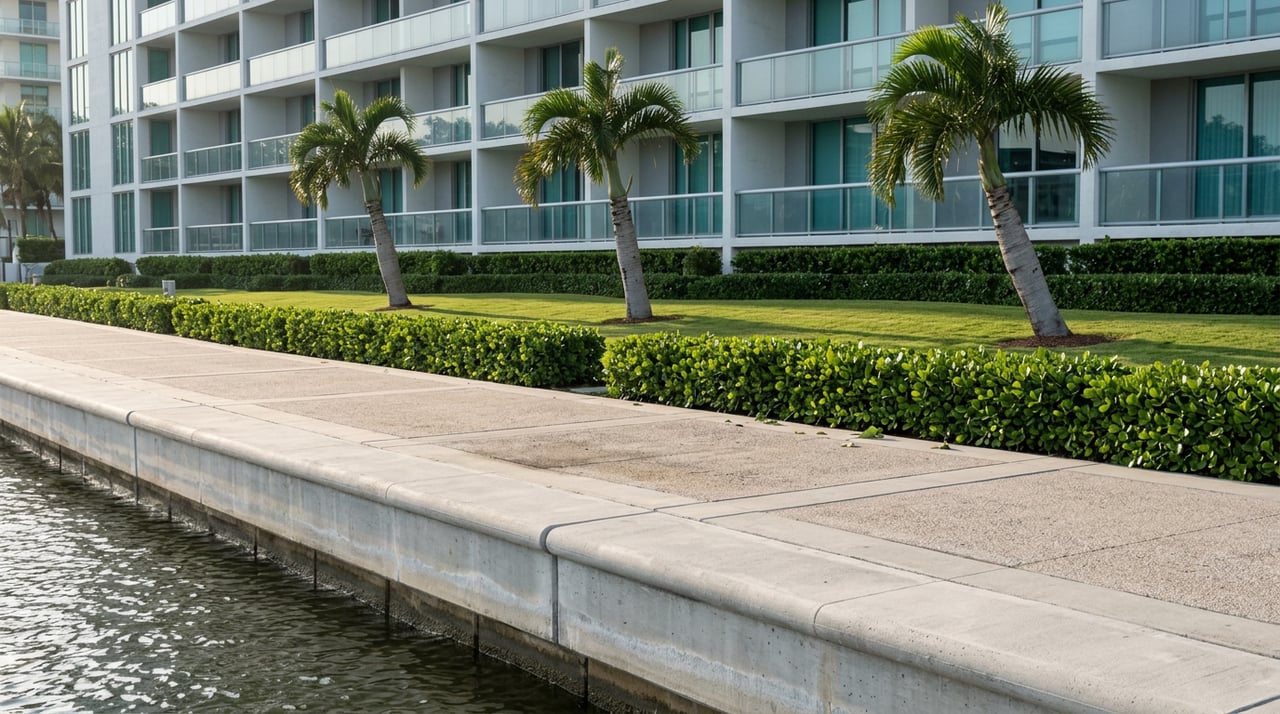
If you have walked past the Village Shops on Venetian Bay this month and noticed new fencing staged near the water, it may not be clear which project is underway. Seawall work here can look like a condo association project, with a building board approving work on the association's timeline. This project is different, as was the previous phase.
The seawall running along a roughly 3,300-foot stretch of Gulf Shore Boulevard North, covering the outlots labeled A through F on the city's plat maps, belongs to the City of Naples. Not by choice, exactly. A 2021 circuit court ruling settled a dispute over who was responsible for that shoreline, and the answer was the city, because the land had been dedicated by plat to Collier County and later to Naples itself. That ruling helps explain why the project follows a city capital-project process rather than an HOA process.
How the Seawall Project Took Shape
It is easy to watch a fence go up near the water and assume it is tied to whichever condo building sits closest. For the outlot seawalls, responsibility belongs to the city. The seawall failure that triggered all of this traces back to Hurricane Irma in 2017, and it was the Gulf Shore Association of Condominiums, not any single building, that pushed the issue in front of Naples City Council as far back as May 2018. It took until 2021 for a settlement agreement and court ruling to formally establish that the city owns the maintenance obligation for the outlot seawalls, with one carved-out exception for a bulging section next to the Venetian Bay North Yacht Club that needed attention regardless of how the larger dispute resolved.
That carve-out became Phase 1. Since then, the municipal capital project has moved through engineering studies, city council votes, grant applications, and competitive bidding. Along a city-owned right of way, those steps are part of the work, even when they are not visible from the sidewalk.
What Phase One Actually Looked Like On The Ground
Phase 1 focused on Outlot E, the 700-foot section beginning at 4500 Gulf Shore Boulevard North, the same stretch where that bulging seawall sat next to the Venetian Bay North Yacht Club. The city retained Coastal Engineering Consultants in mid-2021, council directed staff toward a specific design concept that November, and the construction contract went to Kelly Brothers, Inc. in September 2022 for just under $2.1 million. The city also secured a $375,000 state grant to help cover the cost.
Construction was not limited to the wall itself. Residents who lived through it saw the sidewalk, curbing, a parking lot, and the landscaping along that section rebuilt alongside the seawall, not as an afterthought but as part of the same contract. According to the neighborhood's condo association, that section wrapped up roughly two years ago, putting completion somewhere around 2024, about six years after the association first raised the issue with council.
Reading The Calendar Instead Of The Fencing
Phase 2 is a larger commitment by every measure that matters. It begins at the Village Shops' southern property line and runs approximately 1,510 linear feet to the south, more than double the length of Phase 1. The city has engaged Stantec Consulting Services for design and permitting, and it recently secured a $3.75 million state grant, roughly ten times the grant that helped fund Phase 1's construction. The association's own February update on the project put it plainly: the seawall replacement will again include the sidewalk, curbing, parking lot, and landscaping, mirroring what happened at Outlot E.
Here is where the timeline becomes genuinely useful rather than just historical trivia. Phase 1 spent roughly a year in active design and council approvals before a construction contract existed, and the visible work, the fencing and equipment residents actually saw, was compressed into a much shorter window than the years of budget and engineering process that preceded it. Phase 2 is currently sitting in that same early stage: funding secured, design firm engaged, no construction contract yet awarded as of this writing. If the pattern holds, this season and likely next are more about engineering drawings and permitting than about heavy equipment on the boulevard. Given that Phase 2 covers more than double the linear footage of Phase 1, it would be reasonable to expect the design and permitting runway to take at least as long, possibly longer, before a contractor breaks ground.
Here is a side-by-side look at how the two phases compare so far.
| Phase 1 (Outlot E) | Phase 2 | |
|---|---|---|
| Length | Approximately 700 linear feet | Approximately 1,510 linear feet |
| Location | Begins at 4500 Gulf Shore Boulevard North | Begins at the Village Shops' southern property line, extends south |
| Design engineer | Coastal Engineering Consultants | Stantec Consulting Services |
| Construction contractor | Kelly Brothers, Inc. | Not yet awarded |
| Construction contract value | $2,099,995.31 | Not yet determined |
| State grant secured | $375,000 | $3.75 million |
| Status as of this writing | Completed, roughly two years ago | Design and permitting underway |
Two Different Fences, Two Different Projects
There is a second, unrelated reason for construction activity along this same corridor right now, and confusing it with the seawall project is an easy mistake to make. Kolter Urban began early site work at 3300 Gulf Shore Boulevard, an eight-story residential building planned for a former club site near the Moorings, with seawall and foundation work starting in early 2026 as a private construction project, followed by hundreds of helical piling installations for the building itself. That work belongs to the developer and its own contractor, not to the city, and it runs on a private construction schedule aimed at a 2027 or 2028 completion, not the multi-year municipal grant cycle governing the city's outlot seawalls.
The city’s seawall project is in design and permitting, while the work at 3300 Gulf Shore Boulevard is a private development. They happen to share a street.
What This Means For Your Walk This Season
None of this changes daily life much yet. The condo association's own guidance to residents has been that the city intends to coordinate construction phases to minimize disruption, with the caveat that temporary lane adjustments or access changes are possible once work begins in earnest. For now, that means occasional staging and fencing near the southern edge of the Village Shops property is worth expecting, but a full closure of your regular walk to dinner is not yet on the table based on what has been announced.
The upside, when Phase 2 eventually reaches construction, is the same one Outlot E residents got a few years back: a rebuilt sidewalk, fresh curbing, a redone parking area, and new landscaping alongside a seawall built to hold up better than the one it replaces. It is a slow way to get there, shaped by a legal ruling and a state grant cycle rather than a builder's schedule, but it is the same shoreline every resident along Gulf Shore Boulevard North already depends on for the walk to Venetian Village.
If you are watching this corridor for reasons beyond your evening walk, whether you already own here or are weighing a move to this stretch of the coast, Annie Hagstrom follows these Naples neighborhoods closely enough to separate a city infrastructure timeline from a private development schedule, and to tell you which one actually affects the property you are looking at. Book an appointment to talk through what either one means for your plans.
This article is general information, not legal, tax or financial advice. Consult a qualified professional about your situation.